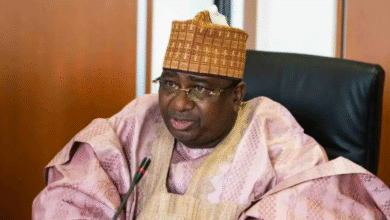
Wike urges EU countries to partner with FCT on investments, cultural exchange, others
Minister of the Federal Capital Territory, Nyesom Wike, has met with the European Union (EU) Heads of Mission in Abuja to pitch the FCT as a prime destination for international investment. Speaking at the European Union House on Tuesday, Wike highlighted the “Renewed Hope Agenda” of President Bola Ahmed Tinubu, urging EU member states to partner with the FCTA in sectors such as agriculture, real estate, tourism, and solid minerals.
During the session, chaired by Ambassador Gautier Mignot and attended by envoys from 16 European nations, Wike detailed the administration’s progress in infrastructure and security. He noted the construction of 12 new Divisional Police Headquarters across the six Area Councils, emphasizing that modernizing transport and water supply remains a top priority to foster economic growth.
The Minister also addressed Nigeria’s evolving political and judicial landscape, emphasizing a maturing democracy. He shared his perspective on the legal framework of elections, stating, “In the newly ammended Electoral Act, there is provision for electronic transmission of results. But because of our peculiarities, it was included that where electronic transmission fails, manual transmission can be used. Meanwhile, there is no such provision in the 2022 ammended Electoral Act.”
Wike further highlighted the improved synergy between the Executive and the Legislature, describing them as “partners-in-progress.” Reflecting on the shift toward merit-based governance, he said, “Compared to earlier periods, there is a decline in highly volatile and rancorous politicking that characterized the relationship between the Executive and the Legislature. The relationship between these two key institutions have become that of ‘partners-in-progress’ in the making and implementation of policies and programmes for the welfare of Nigerians.”
Regarding national economic policy, Wike defended the bold reforms undertaken by the Tinubu administration, including subsidy removal and the unification of foreign exchange rates. He acknowledged the resulting hardships but pointed to social interventions like the conditional cash transfer and the student loan scheme as vital cushions for vulnerable citizens during this fiscal restructuring.
Despite admitting to security challenges like banditry and insurgency influenced by Sahelian instability, the Minister assured the envoys of a strengthened security architecture. He concluded by thanking the EU for their invitation, stating, “I thank the European Union Delegation to Nigeria for the invitation and continued partnership with the Nigerian Government in advancing shared values of development, stability, and prosperity.”